
"Whiskey" Business Part II: Further Evaluating Canada's Retaliatory Response to U.S. Tariffs Post-IEEPA

Nearly seven months after Learning Res., Inc. v. Trump, 607 U.S. 229 (2026) invalidated President Trump’s punitive tariff scheme under IEEPA, its re-ignition—now marshaled under 19 U.S.C. § 1338—pushes lawmakers, alcohol (and all other) manufacturers and retailers, and everyone else with a stake in North American interdependence toward a point of no return.

U.S. President Donald Trump and Canadian Prime Minister Mark Carney exchange tense glances at the 2025 G7 Summit in Kananaskis, Alberta.[1]
Background/Synopsis of Part I
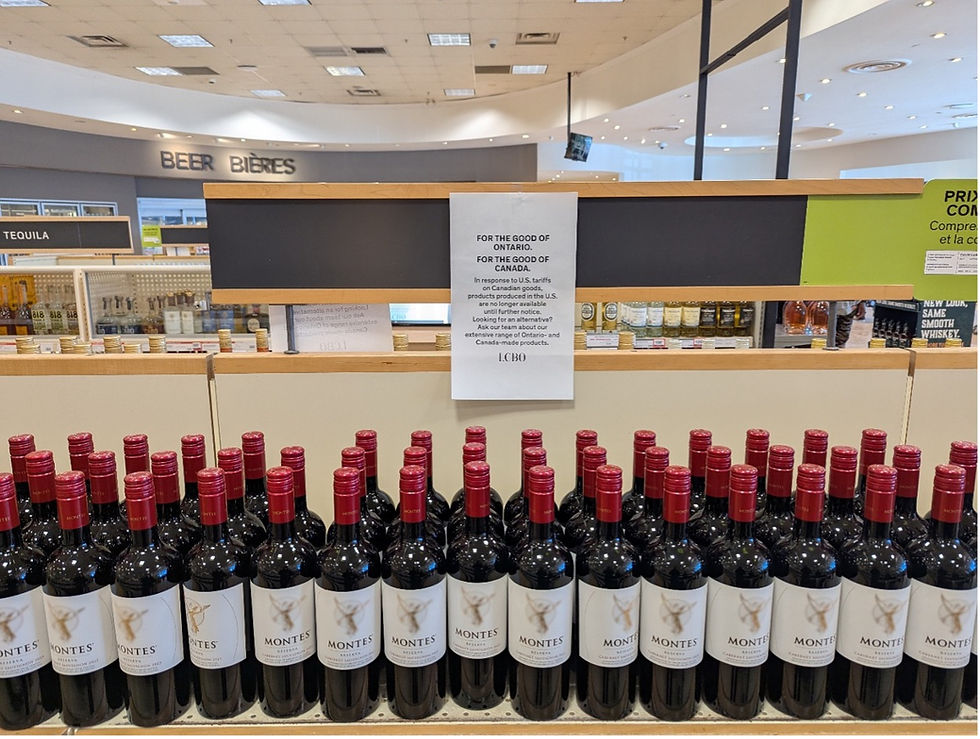
On March 31, 2026, the Blog published Part I of this analysis concerning Canada’s federal and provincial response to President Trump’s “retaliatory” tariffs.[2] Part I explained how provinces such as Ontario were able to uniquely respond to Washington’s pressure by unilaterally pulling American alcohol from the shelves of the Liquor Control Board of Ontario (LCBO) (and other provincial equivalents), contributing to a 9% decrease in U.S. liquor exports in Q2 2025 and an 85% decrease in exports to Canada over the same timeframe. These moves seemed to correspond with Canada’s broader shift away from its historical reliance on the United States as a trade partner; Prime Minister Mark Carney’s 2026 Davos speech went so far as to call for a unity of “middle powers” as a counterbalance to American economic hegemony.
Brass Tacks: Where Are We Today?
In a 6-3 decision, the United States Supreme Court invalidated the Trump Administration’s authority to unilaterally institute tariffs on foreign nations under the International Emergency Economic Powers Act of 1977 (IEEPA).[3] Writing for the majority, Chief Justice John Roberts categorized the actions as an expression of taxation powers, which rest solely within Congressional legislative power.[4] President Trump struck back on July 20, 2026, issuing three Proclamations to offset alleged “Canadian Discrimination Against the Commerce of the United States” against dairy, motor vehicles, and alcoholic beverages.[5] In those Proclamations, President Trump invoked 19 U.S.C. § 1338, which he claims confers upon the President near unilateral power to “impose duties on imports of a foreign country’s discrimination against or unequal imposition on the commerce of the United States.”[6] Unlike IEEPA, Section 338 has seldom been litigated in American federal courts, giving the Trump administration a near blank slate to blitz its northern neighbor with little risk of judicial hindrance.[7]
Then, on September 8, 2026, President Trump dropped a second, much more aggressive Proclamation, directing the complete and total exclusion of the importation of Canadian alcohols previously subject to additional duties under the Proclamations.[8] Under Section 338, exclusion is governed separately from tariff imposition. Section 338 (b) states:
If at any time the President shall find it to be a fact that any foreign country has not only discriminated against the commerce of the United States, . . . the President is authorized, if he deems it consistent with the interests of the United States, to issue a further proclamation directing that such products of said country or such articles imported in its vessels as he shall deem consistent with the public interests shall be excluded from importation into the United States.[9]
Throughout the turmoil, Canadian actors—both federal and provincial—have been steadfast in their messaging: the United States does not have any legal, moral, or ethical right to infringe upon any aspect of their sovereignty.[10]
Why Not Target the Provinces?
Section 338 defines a “foreign country” as “any empire, country, dominion, colony or protectorate, or any subdivision or subdivisions thereof (other than the United States and its possessions), within which separate tariff rates or separate regulations of commerce are enforced.”[11] Under this definition, one can construe Ontario, Québec, and every other of Canada’s eight[12] provinces and three territories as individual targets for President Trump’s Section 338 tariffs, especially considering the autonomy exercised by those governments over their respective liquor boards.[13] Prime Minister Carney does not wish to escalate the conflict but nonetheless believes Canada’s response is unavoidable and necessary to protect its workers, companies, and communities.[14] Yet the Trump Administration continues to relentlessly target Ottawa[15] while Ontario Premier Doug Ford jabs at antics such as the renaming of Lake Ontario.[16]
In an op-ed for Policy Magazine, Canadian trade expert Carlo Dade[17] argues that this provincial differentiation has already been fulfilled through Section 232 tariffs on steel and aluminum in effect since June 1, 2026.[18] Unlike Section 232’s implicit power, Section 338 arms the United States with the power to exploit Canada’s “somewhat unique vulnerability to internal [provincial] division over trade with the U.S. and tariff exposure” through a “naming and shaming” scheme.[19] Dade argues that the potential for a carve-out system—one that rewards a province’s behavior and tempts another—can cause internal electoral strife between various factions faced with the choice of resistance versus capitulation.[20] Additionally, the Trump Administration’s national approach could very likely “make an example of Canada for other countries that may be considering retaliation against U.S. trade arm-twisting and tariffs.”[21]
Whatever President Trump’s rationale may be, one thing is certain: in the United States, besides self-identified “MAGA Republicans,” a majority of Democrats, Republicans, and independents strongly oppose raising tariffs on Canadian goods.[22]
Is There Any International Legal Redress?
Despite the apparently unlimited power of Section 338, the United States and Canada are still bound by both the World Trade Organization (WTO) and the United States-Mexico-Canada Agreement (USMCA). Under normal circumstances, the USMCA allows products that meet the following criteria, which are classified as “originating” in North America, to receive duty-free treatment:
1. Materials from North America, such as American lumber, Mexican avocados, or Canadian mineral ores;
2. Products wholly manufactured from originating materials in North America;
3. Products manufactured from non-originating materials that undergo “substantial transformation” in North America; or
4. Products assembled in North America without substantial transformation but meeting a product-specific regional content/costs requirement . . . .[23]
However, as noted by legal commentators, no product within either of the three July Proclamations (motor vehicles, dairy, and alcohol) which would normally be subject to preferential treatment is exempt from the additional 50% duty—and by extension, the importation ban.[24]
This leaves the WTO. Procedurally, disputes between two or more WTO Member States result in formal consultation with WTO’s Dispute Settlement Body (DSB).[25] If the parties fail to reach an agreement through these consultations, the dispute proceeds to an ad hoc settlement hearing panel, where the parties may present their arguments.[26] Upon the conclusion of the hearings, the panel issues a report that “includes its findings on whether the contested measure is consistent with WTO obligations” and subsequent recommendations.[27] Finally—and only as a last resort—WTO Member States are allowed to use trade-related sanctions against another Member State that has been found to be in violation of a WTO agreement.[28] While the corpus of WTO proceedings does not establish formal stare decisis, its panel reports—along with reports issued by its predecessor, the General Agreement on Tariffs and Trade (GATT)—create “legitimate expectations” within mediation and arbitration proceedings, and should be considered in later disputes exhibiting similar fact patterns.[29]
A particularly instructive WTO proceeding, ironically, involved a ban on the sale of American alcohol.[30] In 2015, after British Columbia’s government adopted more than sixty reforms relating to the sale of alcohol,[31] grocery stores—which at that time were just granted authority to sell wine—were prohibited from stocking their shelves with products other than those which originated in the province.[32] Instead, imported wines could only be sold at a “store within a store,” requiring separate access and separate cash registers for sale.[33] The United States requested a consultation with Canada, claiming British Columbia’s actions violated Article III.4 of the GATT (1994).[34] The Article states:
The products of the territory of any contracting party imported into the territory of any other contracting party shall be accorded treatment no less favourable than that accorded to like products of national origin in respect of all laws, regulations and requirements affecting their internal sale, offering for sale, purchase, transportation, distribution or use. The provisions of this paragraph shall not prevent the application of differential internal transportation charges which are based exclusively on the economic operation of the means of transport and not on the nationality of the product.[35]
But the panel did not need to determine the claim’s legal sufficiency; rather, the issues were ironed out independently as part of the broader adoption of the USMCA.[36] In a series of letters to the United States, Canada agreed to compel British Columbia to eliminate its challenged rule no later than November 1, 2019.[37] In return, the United States agreed to suspend any further action involving the WTO once British Columbia came into compliance with Art. III.4.[38]
Will This “Whiskey” Wager Pay Off?
While Request for Consultations by the United States, Canada—Measures Governing the Sale of Wine in Grocery Stores provides a similar factual basis to today’s situation, it is analogically imperfect: British Columbia did not categorically refuse to sell American alcohol on its grocery store shelves, and the Trump Administration of eight years prior seemed much more willing and open to involving neutral arbitral bodies to resolve allegedly discriminatory actions by another nation-state. The unresolved question seems to be whether the provinces’ measures—excluding American alcohol from their shelves entirely—can be amicably resolved through USMCA or WTO-based measures, instead of a further escalation of a wildly unpopular trade war.
A psychoanalysis of President Trump’s decision-making model merits more attention: his tactics largely still seem consistent with the philosophy he developed in The Art of the Deal:
Much as it pays to emphasize the positive, there are times when the only choice is confrontation. In most cases I’m very easy to get along with. I’m very good to people who are good to me. But when people treat me badly or unfairly or try to take advantage of me, my general attitude, all my life, has been to fight back very hard. The risk is that you’ll make a bad situation worse, and I certainly don’t recommend this approach to everyone. But my experience is that if you’re fighting for something you believe in—even if it means alienating some people along the way—things usually work out for the best in the end.[39]
The British Columbia dispute ultimately ended when the United States and Canada bilaterally negotiated changes to underlying provincial measures. There was no battle of ego—only cooperation. It is unclear whether this dispute will end in a similar fashion, but what is clearer is that every additional round of retaliation makes the bargain more expensive and risky for all parties involved. The North American alcohol market will be difficult to fully restore, even if all policy were to return to normal tomorrow. Until the parties find the will to cooperate, it is almost impossible to see how anything will, in President Trump’s own words, “work out for the best in the end.”
-----------------------------------------------------------------------------------------------------
[1] President Donald Trump attends the G7 Summit in Canada, Wikimedia Commons (Jun. 16, 2025), https://commons.wikimedia.org/wiki/File:P20250616DT-0096_President_Donald_Trump_attends_the_G7_Summit_in_Canada.jpg.
[2] See generally Daniel LaSalle, “Whiskey” Business: Evaluating Canada's Retaliatory Response to U.S. Tariffs and Its Effects on American Alcohol Producers - Part I, Vill. Int’l L. Soc’y Blog (Mar. 31, 2026), https://www.vilsb.com/post/whiskey-business-evaluating-canada-s-retaliatory-response-to-u-s-tariffs-and-its-effects-on-amer.
[3] See generally Learning Res., Inc. v. Trump, 607 U.S. 229 (2026).
[4] Id. at 240–42 (“‘A tariff,’ after all, ‘is a tax levied on imported goods and services.’”) (quoting Christopher A. Casey, Cong. Rsch. Serv., U.S. Tariff Policy: Overview 1 (2025)).
[5] Proclamation 11046, Imposing Additional Duties To Offset Canadian Discrimination Against the Commerce of the United States With Respect to Alcoholic Beverages, 91 Fed. Reg. 46639 (July 20, 2026); Proclamation 11047, Imposing Additional Duties To Offset Canadian Discrimination Against the Commerce of the United States With Respect to Dairy, 91 Fed. Reg. 46653 (July 20, 2026); Proclamation 11048, Imposing Additional Duties To Offset Canadian Discrimination Against the Commerce of the United States With Respect to Motor Vehicles, 91 Fed. Reg. 46663 (July 20, 2026).
Note, however, that the effective date of each Proclamation was temporarily suspended for three days on Aug. 18, 2026, after Canada committed to removing the allegedly discriminatory barriers; see Proclamation 11056, Temporary Suspension of Additional Duties To Offset Canadian Discrimination Against the Commerce of the United States With Respect to Alcoholic Beverages, Dairy, and Motor Vehicles, 91 Fed. Reg. 54789 (Aug. 18, 2026). The three-day period subsequently lapsed, and the additional ad valorem duties became effective.
[6] Proclamation 11048, supra note 5. Many scholars describe Section 338 as a “zombie statute.” See Alan Wm. Wolff, Trump Invoked a Zombie Statute to Justify Tariffs on Canada, Peterson Inst. for Int’l Econ. (Sept. 3, 2026, at 9:55 ET), https://www.piie.com/blogs/realtime-economics/2026/trump-invoked-zombie-statute-justify-tariffs-canada.
[7] Wolff, supra note 6.
[8] Proclamation 11061, Excluding Certain Canadian Alcoholic Beverages from Importation into the United States in Response to Continued Discrimination Against the Commerce of the United States with Respect to Alcoholic Beverages, 91 Fed. Reg. 58311 (Sept. 8, 2026).
[9] 19 U.S.C. § 1338(b) (emphasis added).
[10] Liam Casey & Allison Jones, Premier Doug Ford Tones Down Rhetoric in War of Words with Donald Trump, Toro. CityNews (Aug. 25, 2026, at 11:10 ET), https://toronto.citynews.ca/2026/08/25/ontario-premier-doug-ford-tones-down-rhetoric-in-war-of-words-with-donald-trump/.
[11] 19 U.S.C. § 1338(i).
[12] There are, in fact, ten provinces of Canada—Saskatchewan and Alberta do not have provincial bans on American alcohol imports. However, the Saskatchewanian provincial government, much to Trump’s ire, imposed a 50% import fee. See Press Release, Government of Saskatchewan, Saskatchewan Brewers and Distillers Support 50 Per Cent Levy on Alcohol Imports from the United States (Sept. 1, 2026), https://www.saskatchewan.ca/government/news-and-media/2026/september/01/saskatchewan-brewers-and-distillers-support-50-per-cent-levy-on-alcohol-imports-from-the-united-stat.
[13] See id.; see also LaSalle, supra note 2.
[14] Ian Austen, Carney Tells Canadians: Retaliation Against U.S. Tariffs Was Unavoidable, N.Y. Times (Sept. 8, 2026), https://www.nytimes.com/2026/09/08/world/canada/carney-tariffs-trade.html.
[15] See Proclamation 11061 supra note 8.
[16] Isaac Callan & Colin D’Mello, Ford Says ‘Beautiful’ Lake Ontario Sign Was Worth $25k Price Tag, Glob. News (Sept. 3, 2026, at 16:18 ET), https://globalnews.ca/news/12046731/doug-ford-lake-ontario-sign-justifies-cost/.
[17] Dade is the Director of International Policy and head of the New North America Initiative at the University of Calgary’s School of Public Policy, a member of the Expert Group on Canada-US Relations, and a member of the Mexican Council of Foreign Relations (COMEXI). See U. of Calgary Profiles, Carlo Dade, https://profiles.ucalgary.ca/carlo-dade (last visited Sept. 16, 2026, at 21:02 ET) (discussing Carlo Dade’s academic and professional background).
[18] Carlo Dade, Trump’s 338 Tariffs as Provincial Divide and Conquer, Pol’y Mag.: Can. Pol. & Pub. Pol’y (July 22, 2026), https://www.policymagazine.ca/trumps-338-tariffs-as-provincial-divide-and-conquer/. Generally, Section 232 tariffs empower the President to levy import taxes for the protection of national security. See 19 U.S.C § 1862.
[19] See id.
[20] See id. After all, Alberta is slated to hold a referendum on its independence later this year. See Alta. Referendum 2026, https://albertareferendum2026.ca/ (last visited Sept. 16, 2026, at 21:19 ET). The Author intends to cover this topic in a subsequent Blog post, expected Spring 2027.
[21] Id.
[22] Taylor Orth, A Record 38% of Republicans Say Canada is Unfriendly or an Enemy of the U.S., YouGov (Sept. 1, 2026), https://yougov.com/en-us/articles/55478-record-high-38-percent-republicans-canada-unfriendly-enemy-of-the-united-states-august-28-31-2026-economist-yougov-poll.
[23] USMCA-Compliant Products Get Temporary 25% Tariff Relief Starting March 7, Honigman (Mar. 7, 2025) (emphasis added), https://www.honigman.com/alert-2897. As of 2024, under the USMCA, a vehicle must contain at least 75% regional content to qualify as originating, with additional workforce wage requirements.
[24] Ryan Last & Daniel N. Anziska, Three Strikes: New 50% Tariffs to Hit Certain Canadian Goods—and USMCA Won’t Save You, Troutman Pepper Locke LLP (July 21, 2026), https://www.troutman.com/insights/three-strikes-new-50-tariffs-to-hit-certain-canadian-goods-and-usmca-wont-save-you/.
[25] Int’l Trade Admin., Trade Guide: WTO Dispute Settlement Understanding, https://www.trade.gov/trade-guide-wto-dsu (last visited Sept. 16, 2026, at 21:25 ET).
[26] Id.
[27] Id.
[28] Id.
[29] Appellate Body Report, Japan—Taxes on Alcoholic Beverages, ¶ E, WTO. Doc. WT/DS8/AB/R, WT/DS10/AB/R, WT/DS11/AB/R (adopted Nov. 1, 1996).
[30] See Request for Consultations by the United States, Canada—Measures Governing the Sale of Wine in Grocery Stores (Second Complaint), WTO Doc. WT/DS531/1 (Oct. 2, 2017).
[31] New Modern Liquor Laws Come Into Effect, B.C. Gov’t News (Jan. 22, 2017, at 10:00 ET), https://news.gov.bc.ca/releases/2017SBRT0003-000121.
[32] See Request for Consultations by the United States, supra note 30.
[33] Off. of U.S. Trade Representative, United States Takes Action Against Canadian Trade Measures That Discriminate Against U.S. Wine (May 25, 2018), https://ustr.gov/about-us/policy-offices/press-office/press-releases/2018/may/united-states-takes-action-against.
[34] Id.
[35] Gen. Agreement on Tariffs and Trade 1994 art. III:4, Apr. 15, 1994, Marrakesh Agreement Establishing the World Trade Organization, Annex 1A, 1867 U.N.T.S. 187, 190 (emphasis added).
[36] Jeff Daniels, The California Wine Industry is a Big Winner in Trump’s New Trade Deal with Canada and Mexico, CNBC (Oct. 3, 2018, at 7:05 ET), https://www.cnbc.com/2018/10/02/california-wine-achieved-major-win-of-more-access-to-canada-with-usmca-trade-deal.html.
[37] Letter from Robert E. Lighthizer, U.S. Trade Representative, to Chrystia Freeland, Minister of Foreign Affairs of Can. (Nov. 30, 2018), https://ustr.gov/sites/default/files/files/agreements/FTA/USMCA/Text/CA-US_Side_Letter_on_Wine.pdf.
[38] Id.
[39] Donald J. Trump & Tony Schwartz, Trump: The Art of the Deal 69 (Ballantine Books 1987).
Comments