
"Whiskey" Business: Evaluating Canada's Retaliatory Response to U.S. Tariffs and Its Effects on American Alcohol Producers - Part I

Updated: Apr 8
President Trump's tariffs levied upon Canadian manufacturers - which in turn spurred intra-provincial boycotts of American beer, wine, and liquor - is backfiring on the very industries President Trump sought to protect.
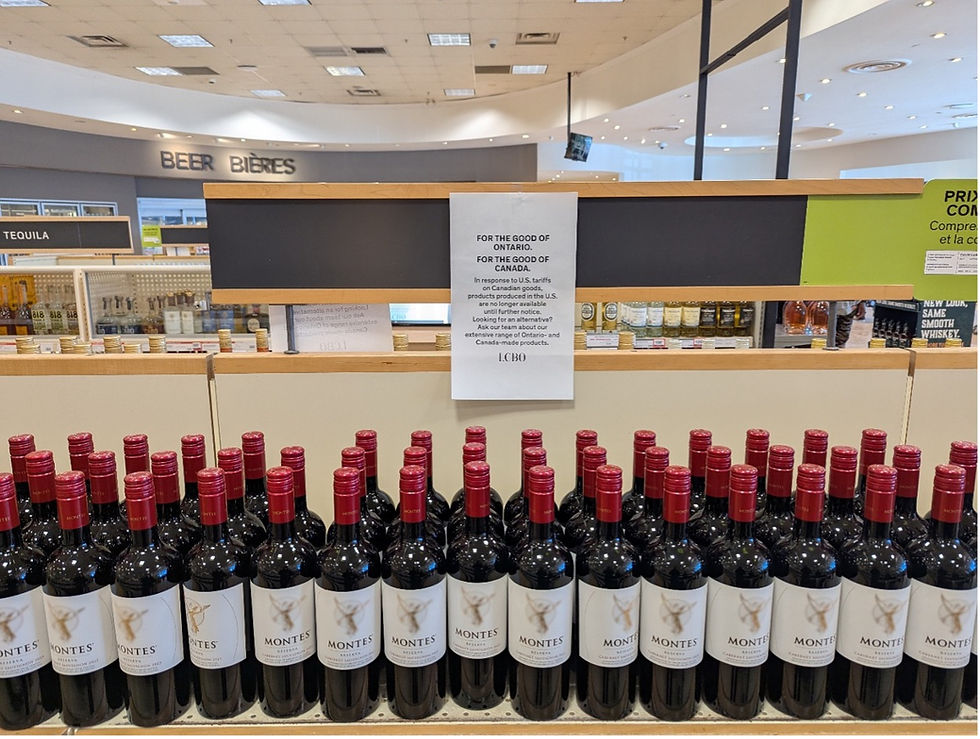
A notice at an Ontario LCBO informing customers that U.S. alcohol products have been removed from shelves in response to U.S. tariffs.[1]
Background – A Pre-Learning Resources World
The beginning of President Trump’s second term in January 2025 marked a renewed era of trade protectionism for the United States, resulting in tariffs up to 50% on nations such as Türkiye, Russia, and India.[2] Among the nations affected is Canada, the U.S.’s northern neighbor, which was hit with a sweeping 25% tariff rate across almost all industries.[3] Over the succeeding seven months, Trump continued to levy more tariffs on Ottawa, such as a 50% rate on steel and aluminum imports.[4] Despite Canada’s historical status as the U.S.’s most reliable and profitable trading partner, Trump justified the tariffs by pointing to a $62 billion trade deficit between the two nations and an alleged “growing presence of Mexican cartels operating fentanyl and nitazene synthesis labs in Canada.”[5]
In response, Canadian Prime Minister Mark Carney announced that Canada would move ahead with 25% tariffs on $155 billion worth of imported goods from the U.S.[6] Many of these tariffs remained in effect until August 1, when Carney announced that tariffs on miscellaneous consumer products—such as alcohol and other manufactured goods—would be eliminated as part of ongoing negotiations between Canada and the United States.[7] However, despite a willingness to negotiate, the damage was done. According to the Pew Research Center, in 2025, nearly two-thirds had an unfavorable view of the United States with an average shift of fifteen percent across all ideological groups.[8] Capitalizing on the patriotic sentiment, most provincial and territorial leaders—notably Ontario Premier Doug Ford—directed their governments to pull American products from shelves, despite the federal government’s rollback.[9]
The Legal and Institutional Authority for Provincial Retaliation
Unlike the U.S., access to alcohol in Canada is mostly controlled by Crown agencies—organizations structured like private corporations but are fully owned by provincial or federal authority.[10] In Ontario, the Liquor Control Board of Ontario (LCBO) is the “importer of record” for all foreign alcohol products into the province.[11] Similar Crown agencies exist in all other provinces and territories, including the Société des alcools du Québec (SAQ)[12] and the British Columbia Liquor Distribution Branch (BCLDB),[13] which have followed Toronto’s lead of boycotting.[14]
Provincial liquor import and distribution are further insulated from Ottawa under the Constitution Act of 1867. Under Sections 92(13) and (16), provinces are granted the power to regulate both “Property and Civil Rights in the Province” and “Generally all Matters of a merely local or private Nature in the Province.”[15] Federal caselaw, such as R. v. Comeau, further enshrines the right of provinces to “adopt[] laws and regulatory schemes directed to other goals that have incidental effects on the passage of goods across provincial borders.”[16] Accordingly, acting within their constitutional authority, LCBO and similar agencies have continued procurement practices that channel the costs of retaliation onto U.S. spirits producers rather than federal trade authorities.
The Hangover: Jim Beam and the Consequences of Retaliatory Harm
In December, distilling giant Jim Beam shocked the bourbon world by announcing that it would halt production at its largest facility, located in Clermont, Kentucky, for 2026.[17] While plant employees have retained their jobs being re-assigned to other locations, the economic reality of the decision paints a grim picture of the U.S. liquor market. Overall exports of U.S. liquor fell 9% in Q2 of 2025, with a staggering 85% decrease in Canadian exports in the same time frame.[18] Along with a noticeable decrease in domestic sales of alcohol, Kentucky bourbon makers are currently sitting on an estimated 16.1-million-barrel surplus in their warehouses, an all-time high.[19]
While extreme, the Jim Beam Clermont closure reflects a rational response to a volatile political situation. The current legal instrument governing U.S-Canada trade, the United States-Mexico-Canada Agreement (USMCA), protects provincial rights to boycott U.S. alcohol products.[20] Section 3-C(8)(b) of the USMCA creates safeguards for manufacturers of products covered under the Agreement by requiring parties such as the LCBO to “not create disguised barriers to trade”; however, 3-C(8)(c) also introduces a “commercial considerations” clause, which can theoretically be construed to include the ongoing trade war as a valid reason for provincial boycotting.[21] Currently, no protective measures exist under the USMCA for manufacturers like Jim Beam.[22] That consequence is not merely a function of institutional design, but instead, as Prime Minister Carney argued at Davos, it is an instrument for hegemonic powers to maliciously leverage economic strength in the name of national protectionism.[23]
The Outlook: How The Boycotts Fit into the Greater Geopolitical Rupture
Even though Ottawa eased its retaliatory tariffs on U.S. alcohol imports in September 2025, the sentiment underlying these moves largely persists.[24] Prime Minister Carney, at the 2026 World Economic Forum, bluntly stated that Canada is “in the midst of a rupture, not a transition.”[25] Without mentioning the United States, Carney continued stating the Trump Administration “[has] begun using economic integration as weapons, tariffs as leverage, financial infrastructure as coercion, [and] supply chains as vulnerabilities to be exploited.”[26]
The Prime Minister’s call for Canada to lead the development of a “third path” for middle powers is nothing short of revolutionary—it is by far the strongest call for sovereignty from traditionally hegemonic powers such as the United States seen by the West in decades.[27] While the implications of this shift extend well beyond alcohol, through actions as conceptually simple as provincial bans, Canada is strategically drafting the blueprint for how other nations can establish their own self-determination.[28] Prime Minister Carney, unlike other foreign actors, routinely resists Trump’s call for a new international order, instead advocating for a more collaborative partnership among allies.[29] Whether this approach will generate broader economic consequences is uncertain, but the Jim Beam plant closure aptly displays how this type of resistance can translate into concentrated harm for private firms well before it produces reciprocal pressure on state actors.
Part II will examine this issue further from a Learning Resources, Inc. v. Trump vantage point.
[1] Sikander Iqbal, LCBO - For the good of Ontario - 20250308-1.jpg, Wikimedia Commons (Mar. 8, 2025), https://commons.wikimedia.org/wiki/File:LCBO_-_For_the_good_of_Ontario_-_20250308-1.jpg.
[2] Michael Lowell, et al., Trump 2.0 tariff tracker, Trade Compliance Resource Hub (Sep. 9, 2025), https://www.tradecomplianceresourcehub.com/2026/02/01/trump-2-0-tariff-tracker/.
[3] Id.
[4] Canadian Economic News, August 2025 Edition, Government of Canada (Aug. 2025), https://www.statcan.gc.ca/en/subjects-start/economic_accounts/canadian-economic-news/2025-august.
[5] Fact Sheet: President Donald J. Trump Amends Duties to Address the Flow of Illicit Drugs Across our Northern Border, The White House (July 31, 2025), https://www.whitehouse.gov/fact-sheets/2025/07/fact-sheet-president-donald-j-trump-amends-duties-to-address-the-flow-of-illicit-drugs-across-our-northern-border/.
[6] Canadian Economic News, March 2025 Edition, Government of Canada (Mar. 2025), https://www.statcan.gc.ca/en/subjects-start/economic_accounts/canadian-economic-news/2025-march.
[7] Id.
[8] Sofia Hernandez Ramones, et al., Canadians’ opinions of the U.S. and its president are at or near historic lows, Pew Research Center (Jul. 24, 2025), https://www.pewresearch.org/short-reads/2025/07/24/canadians-opinions-of-the-us-and-its-president-are-at-or-near-historic-lows/.
[9] Shawn Jeffords, Ontario government urged U.S. distillers to contact their politicians about the need to remove tariffs, CBC News (Jan. 15, 2026), https://www.cbc.ca/news/canada/toronto/ontario-us-booze-ban-9.7045438.
[10] Overview of federal organizations and interests, Gov't of Canada, https://www.canada.ca/en/treasury-board-secretariat/services/reporting-government-spending/inventory-government-organizations/overview-institutional-forms-definitions.html.
[11] Role Of Supplier And Agents, LCBO, https://www.doingbusinesswithlcbo.com/content/dbwl/en/basepage/home/new-supplier-agent/findanagent/RoleofSupplierandAgents.html.
[12] Profile and mandate, SAQ, https://www.saq.com/en/about-saq/profile-mandate.
[13] About the LDB, B.C. Liquor Distrib. Branch, https://www.bcldb.com/about/about-ldb.
[14] Nadine Yousef, Here's what Canadian provinces are doing with all the US liquor they pulled off shelves, BBC (Dec. 8, 2025), https://www.bbc.com/news/articles/cwyp9g7p5p9o.
[15] Constitution Act, 1867, 30 & 31 Vict., c. 3, § 92(13), (16) (U.K.), reprinted in R.S.C. 1985, app. II, no. 5 (Can.).
[16] R. v. Comeau, [2018] S.C.R. 15 (Can.).
[17] Jeffrey Collins, Cloudy future for bourbon has Jim Beam closing Kentucky distillery for a year, Associated Press(Dec. 22, 2025), https://apnews.com/article/jim-beam-bourbon-distillery-shutdown-kentucky-a8303cd04005a9108ff43690faad421b.
[18] American Distilled Spirits Exports 2025 Mid-Year Report, Distilled Spirits Council of the U.S. (Oct. 2025), https://www.distilledspirits.org/wp-content/uploads/2025/10/Export-Report-2025-Mid-Year-FINAL.pdf.
[19] The Bourbon State: Challenges Continue Amid Record Barrel Inventory & Skyrocketing Taxes, Ky Bourbon Trail(Oct. 8, 2025), https://kybourbon.com/industry-news/the-bourbon-state-challenges-continue-amid-record-barrel-inventory-skyrocketing-taxes/.
[20] United States-Mexico-Canada Agreement, Annex 3-C, art. 3-C.1(8)(b)–(c), U.S.-Mex.-Can., Jul. 1, 2020, 134 Stat. 11.
[21] Id.
[22] Id.
[23] Davos 2026: Special address by Mark Carney, Prime Minister of Canada, World Econ. Forum (Jan. 20, 2026), https://www.weforum.org/stories/2026/01/davos-2026-special-address-by-mark-carney-prime-minister-of-canada/.
[24] Zvi Halpern-Shavin and Elena Balkos, U.S.-Canada Tariffs: Timeline of Key Dates and Documents, Blakes (Dec. 19, 2025), https://www.blakes.com/insights/us-canada-tariffs-timeline-of-key-dates-and-documents/.
[25] Davos 2026: Special address by Mark Carney, Prime Minister of Canada, supra.
[26] Id.
[27] Paul Samson, What Comes Next for Global Order After Mark Carney’s Speech, Centre for International Governance Innovation (Jan. 21, 2026), https://www.cigionline.org/articles/what-comes-next-for-global-order-after-mark-carneys-speech/
[28] Id.
[29] Jeet Heer, The Man Who Would Be the Face of the Anti-Trump West,
The Nation (Mar. 11, 2026), https://www.thenation.com/article/world/mark-carney-anti-trump/.


Comments